)

The first comprehensive CRM and DSS platform for Greek DMMOs will gather anonymous visitor data and support the strategic planning of destinations – Pilot projects in Athens and Trikala
Nelios presents LokeyPass, the first comprehensive CRM (Customer Relationship Management) και DSS (Decision Support System) platform in Greece for Destination Management and Marketing Organisations (DMMOs), bringing together high-quality information to support strategic decision-making and the shaping of tourism policy.
Under the motto “The key to a smart destination“, LokeyPass connects the traveller, the destination management organisation and the local market in one environment. Visitors get a tool to experience the place in an authentic, local way, while DMMOs gain, for the first time, a real-time picture of who their visitors are, where they go and what they’re looking for.
LokeyPass also carries each destination’s full identity: logo, colour palette, motto and even its own domain.
Nelios has already launched the first LokeyPass pilots, with Trikala and Athens as the first destinations.
How the platform works: full configurability and anonymous data
The platform is fully configurable and adapts to the needs and characteristics of each destination. DMMO staff manage points of interest, a business catalogue with photos and GPS locations, automatically generated QR codes and user roles (admin and editor) from a single back office. It was designed and developed entirely by the Nelios team, funded by the Recovery and Resilience Facility, and is the company’s first ready-made solution delivered as Platform as a Service (PaaS).
95% of public bodies ready to adopt smart tools
The information gap facing destinations led Nelios to carry out primary research with 431 public bodies, to get a realistic picture of the situation across the country.
The research shows that no destination has a visitor or destination management system (CRM/DMS), while 82.4% rely mainly on ELSTAT data, which is published months later and doesn’t show where visitors go.
Even so, 95% of the bodies say they’re ready to adopt smart tools to base their decisions on.
How LokeyPass maps visitor movement
LokeyPass works as infrastructure for collecting, processing and analysing visitor data, which is then presented to DMMOs through dashboards they can act on. It runs as a closed loop: anonymous browsing intent from the destination’s official website gives the system a starting point before arrival, the traveller activates a pass and shares trip dates and interests, QR scans on the ground confirm real visits, and every scan feeds back into the models so recommendations improve over time.
Depending on each destination’s needs, data collection can be supported by QR code scans, digital mobile wallet cards, geolocation with the user’s consent, IoT devices and integration with Google Analytics 4. Optional modules, such as an IoT connector for smart sensors and digital campaign tracking, can be added per destination. All data is processed in aggregated form to protect anonymity, location tracking is strictly opt-in, and personal login details never reach the DMMO dashboard.
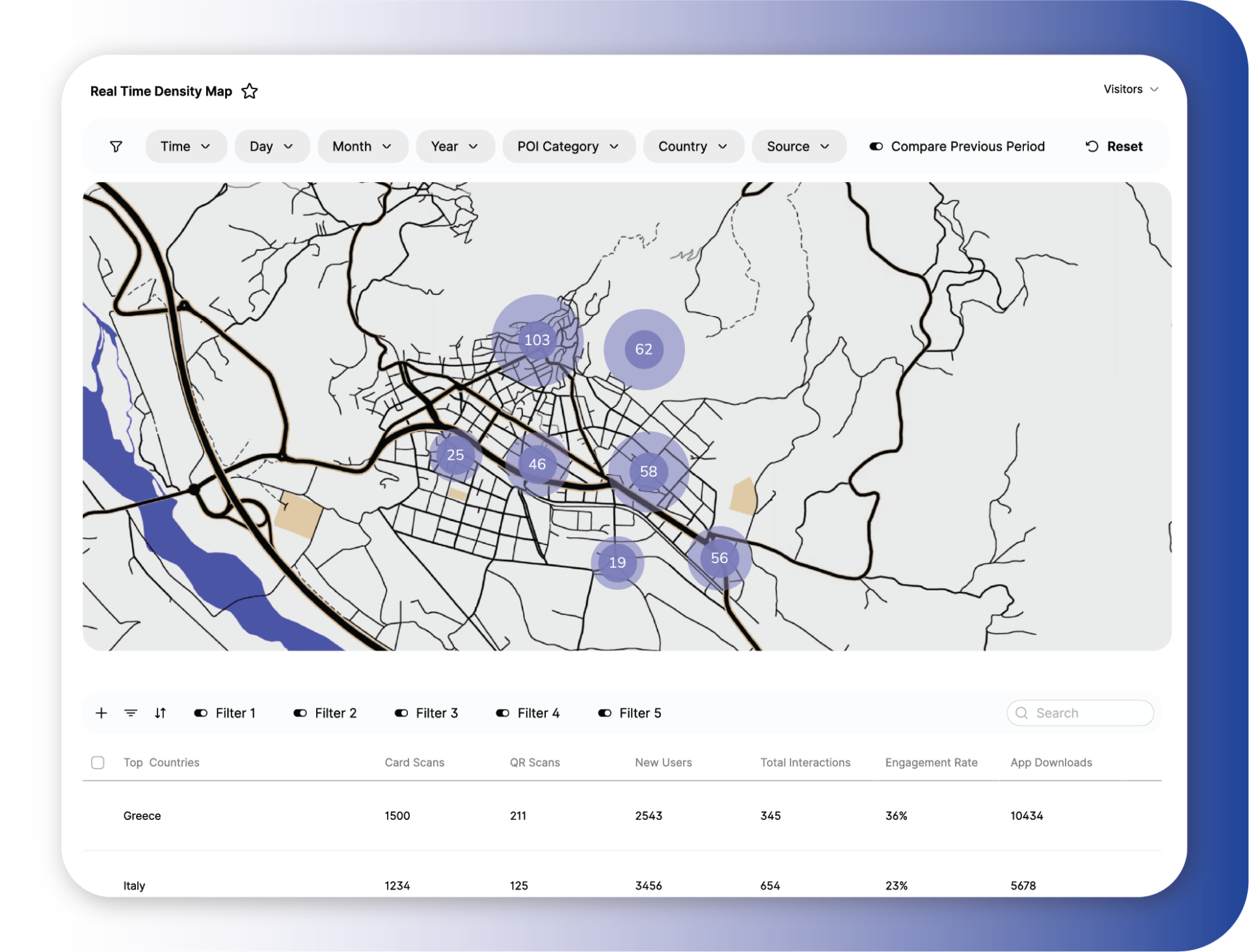
The dashboards map visitor flows as a live density map in 10-minute, 1-hour or 24-hour windows, with filters such as country of origin. This lets a DMMO spot places and times of heavier traffic and track how people respond to events or campaigns. A separate geo view compares source markets, so a DMMO can check whether a campaign in a specific country actually turned into visits on the ground.
Using machine learning models, visitors can be grouped by interests and behaviour into psychographic personas such as wine lovers, outdoor enthusiasts and families. The related reports link these groups to country of origin, popular spots, peak hours, group composition, accommodation type and travel frequency, and sentiment analysis can highlight weak points in the visitor experience. Every QR scan also acts as a reward signal: the model checks whether a recommendation was taken up and adjusts its weights through temporal difference learning, so personas stay grounded in what visitors actually do rather than in survey assumptions.
At business level, reports track card scans, QR scans, total interactions and engagement rate, with trends by day, month or year and benchmarks across sectors and areas. This gives DMMOs evidence of the value the programme brings to the local market.
For carrying capacity management, predictive models identify places at risk of crowding and can trigger incentives along alternative routes. The recommendation engine also deliberately explores the “long tail”, steering suitable visitors toward lesser-known spots and producers instead of the same few hotspots.
The platform also forecasts visitor flows up to 30 days ahead, down to individual points of interest and businesses. The models combine declared travel dates, which work much like forward bookings, with data on weather, public holidays, local events, accommodation occupancy and online searches.
Connecting with the visitor
For travellers, LokeyPass can be linked to an iOS and Android app tailored to each destination’s identity and to a digital card in their mobile wallet. After a short onboarding profile (trip dates, travel party and interests), the card is issued automatically. Through these tools, visitors can be shown personalised recommendations, sights, local flavours, experiences and offers from local businesses, as a list or on an interactive map.
In addition, “Smart Perks” can link museums and landmarks with restaurants and local producers. During busier periods, offers and alternative routes can be promoted to spread visitors more evenly.
LokeyPass will be presented at the Philoxenia exhibition, from 13 to 15 November 2026, in Thessaloniki, at stand C25, Pavilion 13.